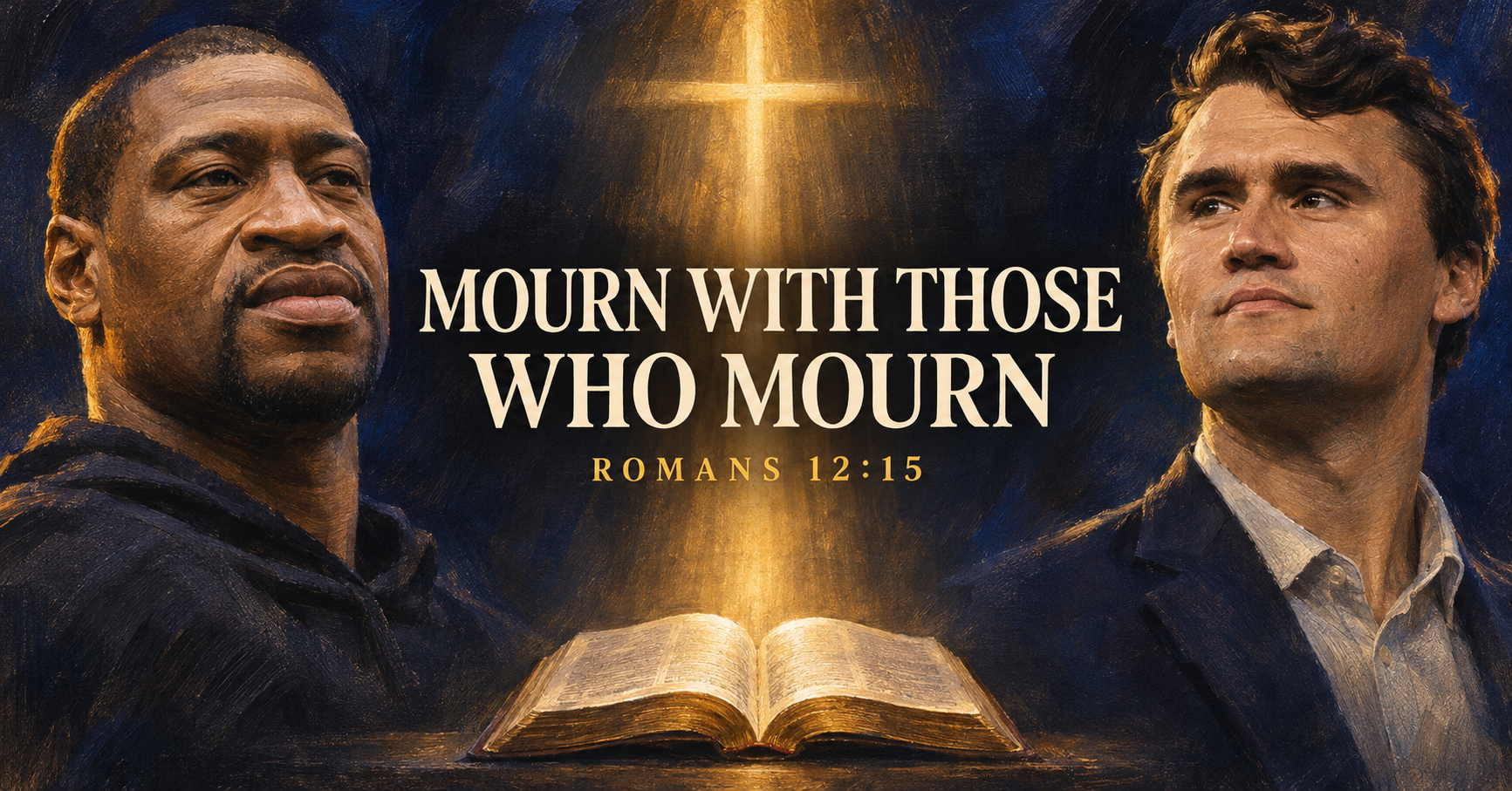
George Floyd and Charlie Kirk became widely known in different ways. Floyd was a former Houston high school athlete whose death in Minneapolis police custody in 2020 drew worldwide attention. Kirk had already spent more than a decade building a national conservative student organization when he was fatally shot during a campus event in 2025. In 2026, two comedians used nearly the same punch line about their deaths. The reaction raises a question for the Me 2Too Movement: do we extend the same compassion when the name changes?
George Floyd’s life before May 25, 2020
Photos taken in 1992 show George Floyd playing football and basketball for Jack Yates High School in Houston. He later recorded with Houston’s DJ Screw under the name Big Floyd. A copy of the mixtape Floyd & Screw was posted online in July 2019, while he was alive. Football photograph · Basketball photograph · Mixtape recording · Track credits
In April 2009, Floyd pleaded guilty in Harris County, Texas, to aggravated robbery with a deadly weapon for an offense committed in 2007. The court entered a firearm finding and sentenced him to five years in prison. Harris County judgment, case 1143230
A photograph taken while Floyd was alive shows him holding a Bible with people involved in a Houston church outreach. In a video recorded during his lifetime, he speaks directly to young people about children being killed by gunfire and urges them to turn away from violence. The copy below was uploaded on June 3, 2020. The original recording date is unverified. Outreach photograph by Nijalon Dunn
Watch Floyd’s appeal to young people on YouTube
On May 25, 2020, Minneapolis police responded to a report that Floyd had used a suspected counterfeit $20 bill to buy cigarettes at Cup Foods. Officers handcuffed and restrained Floyd. The Hennepin County Medical Examiner listed the cause of death as “cardiopulmonary arrest complicating law enforcement subdual, restraint, and neck compression” and classified the manner of death as homicide. The examiner listed arteriosclerotic and hypertensive heart disease, fentanyl intoxication, and recent methamphetamine use as other significant conditions. On April 20, 2021, a Minnesota jury found former Minneapolis police officer Derek Chauvin guilty of second-degree unintentional murder, third-degree murder, and second-degree manslaughter. On June 25, the court entered a conviction on the second-degree murder count and sentenced him to 22½ years in prison. The two lesser counts remained unadjudicated. The Minnesota Court of Appeals affirmed the conviction and sentence in April 2023. In a separate federal case, Chauvin pleaded guilty to violating the civil rights of Floyd and a 14-year-old in a separate incident. On July 7, 2022, the federal court sentenced him to 21 years in prison. Floyd’s killing sparked protests over racial injustice and police violence in the United States and abroad. In 2023, the U.S. Department of Justice reported a pattern of racial discrimination by Minneapolis police against Black and Native American people. Minnesota court record · Hennepin County Medical Examiner’s findings · Minnesota sentencing order · Minnesota Court of Appeals opinion · Federal plea and sentencing · U.S. Department of Justice · United Nations

George Floyd memorial outside Cup Foods, May 27, 2020. Tony Webster, via Wikimedia Commons, CC BY 2.0.

Charlie Kirk’s family, faith, and work with students
Charlie Kirk and William Montgomery co-founded Turning Point USA in 2012, when Kirk was 18. The organization built a national network of conservative chapters at high schools and colleges. It gave students a structure for hosting events, discussing public policy, and developing leadership skills. In 2025, its Club America program expanded its high school organizing and offered leadership training and access to speakers. Turning Point Faith organized events and training for pastors and congregations. Turning Point Action, Kirk’s political organization, helped mobilize voters for Donald Trump in the 2024 presidential election. Associated Press · Club America announcement · Turning Point USA programs
Kirk was married to Erika Kirk, and they had two children. He spoke publicly about his Christian faith and described setting aside a weekly Sabbath, turning off his phone to spend time with his family and attend church. On September 10, 2025, Kirk was fatally shot while speaking at a student-sponsored Turning Point USA event at Utah Valley University in Orem. He was 31. Louisiana legislative resolution · Kirk’s remarks on Sabbath observance · Utah Department of Public Safety · Associated Press

Charlie Kirk at the Young Women’s Leadership Summit, June 7, 2024. Gage Skidmore, via Wikimedia Commons, CC BY-SA 2.0. The Wikimedia version is cropped from the original.

Watch Kirk’s 2024 Republican National Convention speech, recorded by PBS NewsHour
What Tony Hinchcliffe and Dave Chappelle said
On May 10, 2026, Tony Hinchcliffe joked during Netflix’s The Roast of Kevin Hart that George Floyd was looking up from the afterlife and laughing so hard he couldn’t breathe. The line echoed Floyd’s pleas during the police restraint that killed him. A spokesperson for the Gianna and George Floyd Foundation criticized the joke. Hart later said he would leave that joke out of his own act while defending roast comedy as a setting where performers push boundaries. Netflix’s roast recap · Minnesota Star Tribune · Los Angeles Times
At Madison Square Garden on November 7, 2026, Dave Chappelle used a closely similar line about Charlie Kirk, imagining Kirk looking up from the afterlife and laughing until he couldn’t breathe. The clips that circulated captured parts of his set. Writing in Inc., an attendee at a subsequent Ohio show reported that Chappelle described the parallel as deliberate and said he was calling attention to what he saw as a double standard. Chappelle had also addressed Floyd’s death in his 2020 performance 8:46. Vulture’s reporting and clip · Firsthand account in Inc. · Watch Chappelle’s 8:46 performance
What should we expect from comedy?
Roast comedy makes room for provocation. Repeating a joke with a different name can expose how differently an audience responds when the subject is someone they identify with. A listener can also recognize the point of the comparison and object to making either death a punch line. People are free to tell hard jokes, and audiences are free to ask whom a joke challenges, whom it hurts, and whether its point is worth the cost.
If you laughed at one joke and objected to the other, what made the difference for you? The setting, the history behind the words, and the comedian’s stated purpose can matter. So can the instinct to give our own side more grace than we give everybody else. The same question applies whichever joke you heard first.
What Scripture asks of us
George Floyd’s life included a serious conviction and, years later, an appeal to young people to turn away from gun violence. Genesis 1:27 grounds human dignity in being made in God’s image. Micah 6:8 calls us to act justly, love mercy, and walk humbly. I can take the harm Floyd caused seriously, hear what he was urging young people to do, and call for accountability for his death.
Charlie Kirk spoke openly about his Christian faith, described setting aside time for his family and church, and helped build an organization that gave young people leadership opportunities. His life also raises a question for anyone with an audience. James 1:19 calls us to be quick to listen and slow to speak and become angry. Ephesians 4:15 calls us to speak the truth in love. When I have a microphone, a platform, or just a comment box, what am I doing with it?
Romans 12:15 calls us to mourn with those who mourn. I can pray for both families and examine how quickly I extend compassion when the person suffering is someone I identify with. Before I share the next joke or clip, I want to pause, hear the fuller story, and choose words I could say with the family in the room.
The Me 2Too challenge
The Me 2Too Movement is about changing the mindsets and habits we carry into the next chapter of our lives. I started with music because a song can open a conversation. What we do after that conversation is where change starts.
- Name it. Think of a joke, post, or comment you reacted to. Ask yourself what made you laugh, defend it, or get angry. Would you react the same way if the names were switched?
- Change it. The next time you’re about to share a clip, check the fuller context. If you disagree, explain why in a way you could say face to face.
- Pass it on. Invite someone who sees the issue differently to talk. Ask what they heard in the joke and listen through their answer before you respond.
What’s one reaction you’d handle differently now? Share it in the comments and say what you’d do next time. Explore the Me 2Too Project · Listen to “Me 2 Too” on SoundCloud